
Mongolia, the land without fences, is much more than just a standard birding tour; a true wilderness, steeped in history and tradition, and long forgotten since Genghis Khan swept across much of Eurasia. Nearly the whole tour is spent camping, wherever we please such is the lay of the land Ðnatural grassland as far as the eye can see, incomparable vistas, endless steppes, the vast Gobi Desert, rich taiga forests and the Hebridean-like landscapes of the Altai mountains make for an incomparable tour.
The country might not have a huge bird list, but for those wanting to see a wealth of bird and mammal life in unspoilt landscapes with fabulous backdrops, there is no other tour like it in Asia. Starting in the taiga forests, Black-billed Capercaille and Chinese Bush Warbler are our first port of call before heading west into the Altai Mountains to visit the breeding ground of HodgsonÕs Bushchat with a supporting cast of Altai Snowcock and Asian Rosy Finch. A large saline lake in the barren, dusty steppe of the Gobi Desert is the breeding grounds of the nomadic Relict Gull, and finally, we head along the northern rim of the Gobi to the deep gorges of Yolyn Am for Kozlov's Accentor, breeding Oriental Plover and bone-crunching Lammergeier.
On this extended tour, we are targeting not just the avian speciality of the country but also the mammals. Visiting the Gobi A protected area for truly wild Bactrian Camel, we have extended days in the Gobi as we seek out other highly sought-after species like Pallas's Cat, Long-eared Jerboa, Mongolian Gazelle, Saiga and Argali. There's also a chance of Snow Leopard, and plenty of night time excursions as we attempt to find as many jerboa species as we can!
Day 1 (22 May):
International arrivals into Chinggis Khaan International Airport (UBN), just south of Ulaanbataar, https://maps.app.goo.gl/LwxzCPkKbWVEo5Ss5, on TK236 at 0720 or KE2043 at 1110, on arrival we’ll head directly east of UB (80km / 2 hours) to Terelj National Park, a wilderness immediately above the city. Lunch will be at a Ger camp, where we can freshen up with showers and lunch, before we move on up to our tented camp, on the edge of the forest. Around the camp species like Pine Bunting, Red-throated Thrush, Taiga Flycatcher, Daurian Jackdaw, Oriental Cuckoo and Siberian Bluetail occur, with an outside chance of Hazel Grouse too. Night camping near Terelj. https://maps.app.goo.gl/5GFZ9KfD3Ndkw1qD7
Day 2:
Our camp is just 300 metres away from a lek of Black-billed Capercaillie. Rising early, we’ll soon hear the bill-snapping calls of lekking Black-billed Capercaillie – the reason for us being here in mid-May, before the leafy summer arrives. Creeping up, allowing them to be used to our excited presence, they should give us mind-blowing views as they display just metres away in the early morning sunshine. After this, we’ll head back to camp for breakfast, spend the mid-morning in the surrounding spruce forest before packing upand heading south to Baga Gazriin Chuluu (290km). Camping at Baga Gazriin Chuluu, where Argali and Pallas’s Cat are possible. https://maps.app.goo.gl/YGPVugWtEHdy9gpM9
Day 3:
Day searching for Pallas’s Cat and Argali. Camping at Baga Gazriin Chuluu.
Day 4:
Morning here again before heading further south, to the edge of the Gobi (420km), we’ll visit a stronghold of Oriental Plover, hopefully including males performing their aerial display. Our first Pallas’s Sandgrouse are also likely. Camping or ger camp. https://maps.app.goo.gl/JHeXauLnMrADcXcF8
Days 5-8:
We’ll spend the days in the mountains and eastern edge of the Gobi Desert. We split our time across 2-3 different camping areas, the scenically spectacular Yolyn Am https://maps.app.goo.gl/CdyV77nVhszTWNXA9. A scenic, craggy valley, in search of Kozlov’s Accentor, Wallcreeper, White-winged Snowfinch, Mongolian Finch, Twite, Chinese Beautiful Rosefinch, Common and Lesser Kestrel, Lammergeier, Cinereous Vulture, Himalayan Griffon, Golden Eagle and Saker Falcon. Mammals are well represented by Siberian Ibex, Daurian and Pallas’s Pika, and Alashan Ground-squirrel. Another area we’ll spend time searching high-and-low for Snow Leopard. A third area in search of the little-known, highly localized Long-eared Jerboa, while Kozlov’s Pygmy and Five-toed Pygmy Jerboa are also possible, along with several other more widespread species of jerboa, camping in this area: https://maps.app.goo.gl/KnpmMqoxxDHrQLP2A. We also have more chances of displaying Oriental Plover, and plenty of Pallas’s Sandgrouse. This remote area we visit is also home to a research center with a reintroduced population of Bactrian Camel.
Day 9:
Some early morning birding around camp, before heading west, in the Gobi proper, towards Shar Khuls and Gobi A Strict Nature Reserve (650km distance in total between days 8 and 9). Birding stops on the way could reveal our first Saxaul Sparrow, Mongolian Finch, Mongolian Ground-jay, Pallas’s Sandgrouse, Desert Wheatear, pallidirostris Great Grey Shrike and Asian Desert Warbler. Mammal-wise, Asian Wild Ass, Goitered and Mongolian Gazelles as possibilities.Where we camp largely depends on our progress today, but it’ll be in the wilds. A night excursion should produce several jerboa species, while there’s always the chance of Long-eared Hedgehog or the spectacular Steppe or even Marbled Polecat.
Day 10:
A day covering the vast terrain inside the heart of the Gobi A (we will cover 200km from one side of the reserve to the other). This is one of two final wildernesses of Bactrian Camel. The other being in the nuclear testing zone of Lop Nur, in Xinjiang. Covering a lot of remote in this undulating, stony desert, a lot of scanning and patience will be required. Birding is slow going out here – Lesser Whitethroat, Turkestan Short-toed Lark, Desert Wheatear and the occasional Mongolian Ground Jay are around, but otherwise our focus is primarily on mammals. In addition to the camels, which are by no means guaranteed, Goitered Gazelle is likely, while ‘Gobi’ Brown Bear, of which fewer than 30 are likely to remain, and Snow Leopard are possible but unlikely. A wild range of tiny botanical gems await, while at night, under the stars, it’s a rodent-fest. At night, various jerboas are likely again.Where we camp largely depends on the movements of the camels and where peeks our own interests. If we see the camels early, we can decide whether to remain looking for other mammals, or move on, getting ahead of ourselves. https://maps.app.goo.gl/TfimPHEpQTibsoat9.
Day 11:
The plan for today is exciting, as we are in the heart of Saiga country. In Mongolia, fewer than 5,000 remain, most of which are in the area we drive through today. On past tours we’ve seen over 100 here quite easily, with much closer views than we get in Kazakhstan. Our end point, arriving in the mid-afternoon is Ikhes Lake (400km). Night camping. Location: https://maps.app.goo.gl/SbQYYFaKaUark8pS6Ikhes Lake is one of the few lakes in the area where Relict Gulls regularly breed, and we hope to arrive at the lake in the early evening and enjoy these stunning gulls in the soft evening light. In addition to the Relict Gulls, the lake also holds breeding Mongolian Gulls, and a range of shorebirds are also likely. Night camping.
Day 12:
We spend the early morning around Ikhes Lake for more views of Relict Gull before heading to the nearby stony deserts looking for the Saiga a rare antelope which still has a reasonable population in the area. After enjoying more desert birds such as Saker Falcon, Steppe Eagle, Upland Buzzard, Pallas’s Sandgrouse, ‘Steppe’ Great Grey Shrike, we head across the centre of the country to yet another wilderness, along the shore of Khukh Lake (500km of which 260km is on dirt roads, 10-11 hours), likely reaching on day 13, while tonight will be in a hotel in Altai City.
Day 13:
Arriving at Khukh Lake at some point in the morning, a splendidly remote location where we will search along the lake shore for breeding Hodgson’s Bushchat, Altai Snowcock, Altai Accentor and the distinctive sushkini Asian Rosy-finch, a very distinctive, silvery-pink taxon which is endemic to this mountain range. Other species could include pallasi Pallas’s Bunting which breeds along the lake, Eversmann’s and Güldenstädt’s Redstart, while the lake holds breeding Black-throated Diver and Mongolian Gulls. Night camping. Location: https://goo.gl/maps/LJgE2EaQYzvcRikA6
Day 14:
After morning birding at Khukh Lake, we head east to Ugii Lake or Sangiin Dalai Lake area (up to 250km). Areas of larch could hold Eversmann’s Redstart, Oriental Cuckoo, Three-toed Woodpecker, Red-flanked Bluetail, while there’s always an outside chance of something rarer like Northern Shrike, should we decided to visit, we can decide this during the tour depending on how previous days have been. Ugii Lake: https://maps.app.goo.gl/V6FcJFpxYFTapjtQ6
Day 15:
Ugii Lake area and head to Bayan Lake (280km along paved road the whole way). Bayan Lake: https://goo.gl/maps/YekAxpcAtZUNxHiX7. Bayan Lake is a small lake in the middle of seemingly nowhere. White-naped Crane, Swan Goose and Asian Dowitcher are among a fine assemblage of waterbirds and waders. Lakeside vegetation hosts good numbers of breeding warblers including Pallas’s Grasshopper Warbler and Paddyfield Warbler, delightful Bearded Reedlings, Common Reed Bunting and lydiae Pallas’s Bunting, a likely future split as ‘Mongolian Bunting’. With luck we might tease a Brown-cheeked Rail into view. More open areas will be our introduction to the exciting array of larks and pipits to be expected on the tour including Asian Short-toed and Mongolian Larks.Hopefully we’ll have time to stop here for birding before carrying on to Khustai National Park (135km, 2 hours). Night at a Ger camp near Khustai. Location: https://goo.gl/maps/BnHfuXzTyRbf3BiEA
Day 16:
Khustai is famous for its population of Przewalski’s Horse, which is our main target here, a fine equine which was extinct in the wild prior to its reintroduction in the 1980’s. Bird-wise, it is a good site for Lesser Kestrel and Amur Falcon, which regularly hunt from the roadside wires, along with Daurian Partridge, Meadow Bunting, Blyth’s Pipit, and a variety of raptors possible. Other mammals possible include Daurian and Long-tailed Ground-squirrels, with a slim chance of Mongolian Gazelle. By late morning we’ll head back east, past Ulaanbaatar, and return to Terelj, to see what breeding passerines have returned to the Taiga forest, birding the late afternoon.
Day 17:
Day at Terelij once again – in a different area to where we started the tour, as instead of galliforms we’ll be searching for recently arrived passerines. The forest edge and scrub should have a variety of singing warblers, including Lanceolated Warbler, while we will also be hoping for a recently arrived Chinese Bush Warbler. Come the afternoon we’ll head to Ulanbataar for a shower, final dinner and proper bed! We haven’t already, we’ll bird the willow scrub, home to White-crowned Penduline-tit, Siberian Long-tailed Rosefinch and Azure Tit, before farewell dinner and toast! Night at Mongolica Hotel, Ulaan Baatar. Location: https://maps.app.goo.gl/T6k2HP3edsNfBCzr5Night close to Chinggis Khaan International Airport, Ulan Bataar.
Day 18 (8 June):
Departures from Chinggis Khaan International Airport (UBN). https://maps.app.goo.gl/BvErRFX58BQ5g3fW8 on TK237 at 0910 or KE2044 at 1300.
Deposit: £ 600 or $ 800
Single room supplement:
£ TBC / $ 300
Maximum group size: 7
Tour cost includes: all accommodation, main meals, internal flights (as stated in itinerary), overland transport, entrance fees, drinking water, tips to local drivers and guides, and guide fees.
Tour cost excludes: International flights, visa, travel insurance, drinks, other items of a personal nature.
Note: we can provide an invitation letter if required for your tourist visa.
Accommodation: comfortable tented camps (one person per tent), with shared facilities.
Only in Ulan Baatar are we likely to stay in a hotel with twin-bed, and single rooms, with private facilities.
At least two nights also spent in fixed yurt tents.
Walking difficulty: generally easy to moderate throughout. The highest we potentially reach is 2,500m.
Expected number of species: 210-240 species.
Number of endemics and range-restricted species: For those well-travelled through China, it's 10-15 new species, most of which are difficult outside of Mongolia, such as Black-billed Capercaille, Hodgson's Bushchat and Altai Snowcock.
This extended customised tour is also concentrating on a number of highly-sought after mammals including Bactrian Camel, Pallas's Cat, Long-eared Jerboa, Mongolian Gazelle, Saiga and Argali.
Our latest tour reports from the region
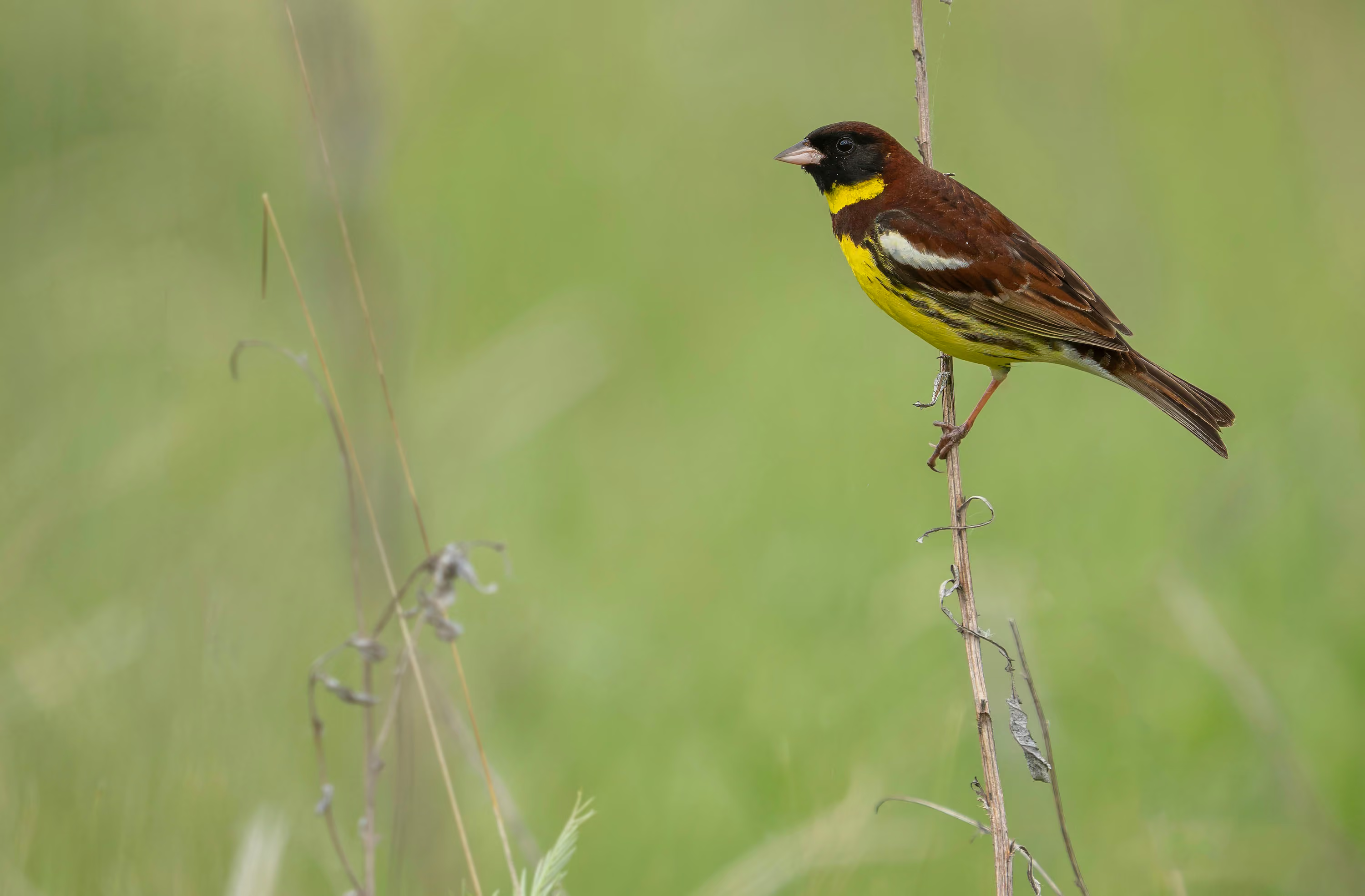
Photos of species possible during the tour. Click on the thumbnails to scroll through.




.avif)
.avif)
.avif)
.avif)
.avif)
.avif)
.avif)


